Crawl space encapsulation that keeps the clay's moisture out of the house
Bare clay under a house gives off water vapor every day of the year, and in a Bowling Green summer the vents pull in air that is wetter than the crawl space can hold. Encapsulation closes both of those doors at once.
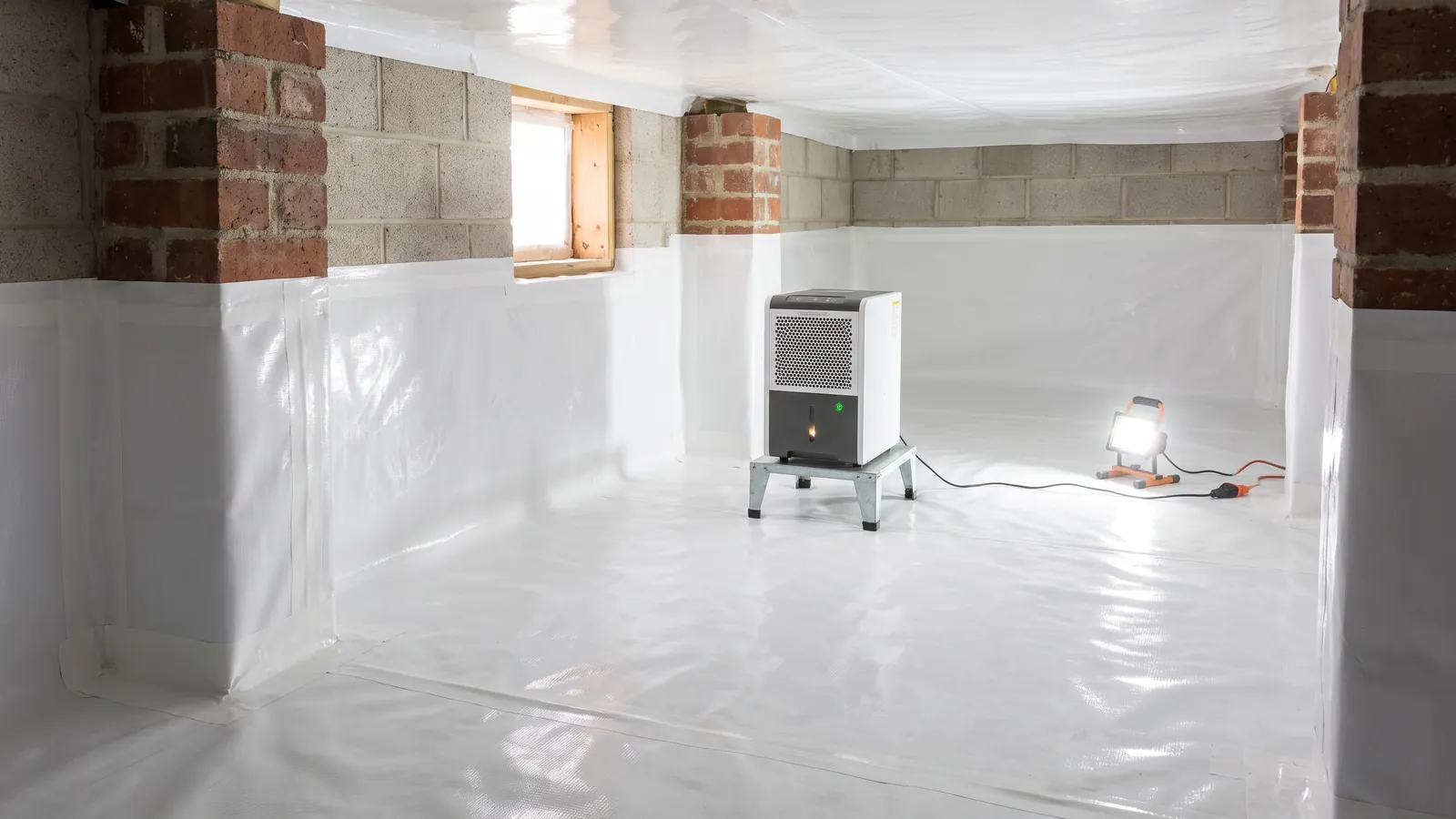
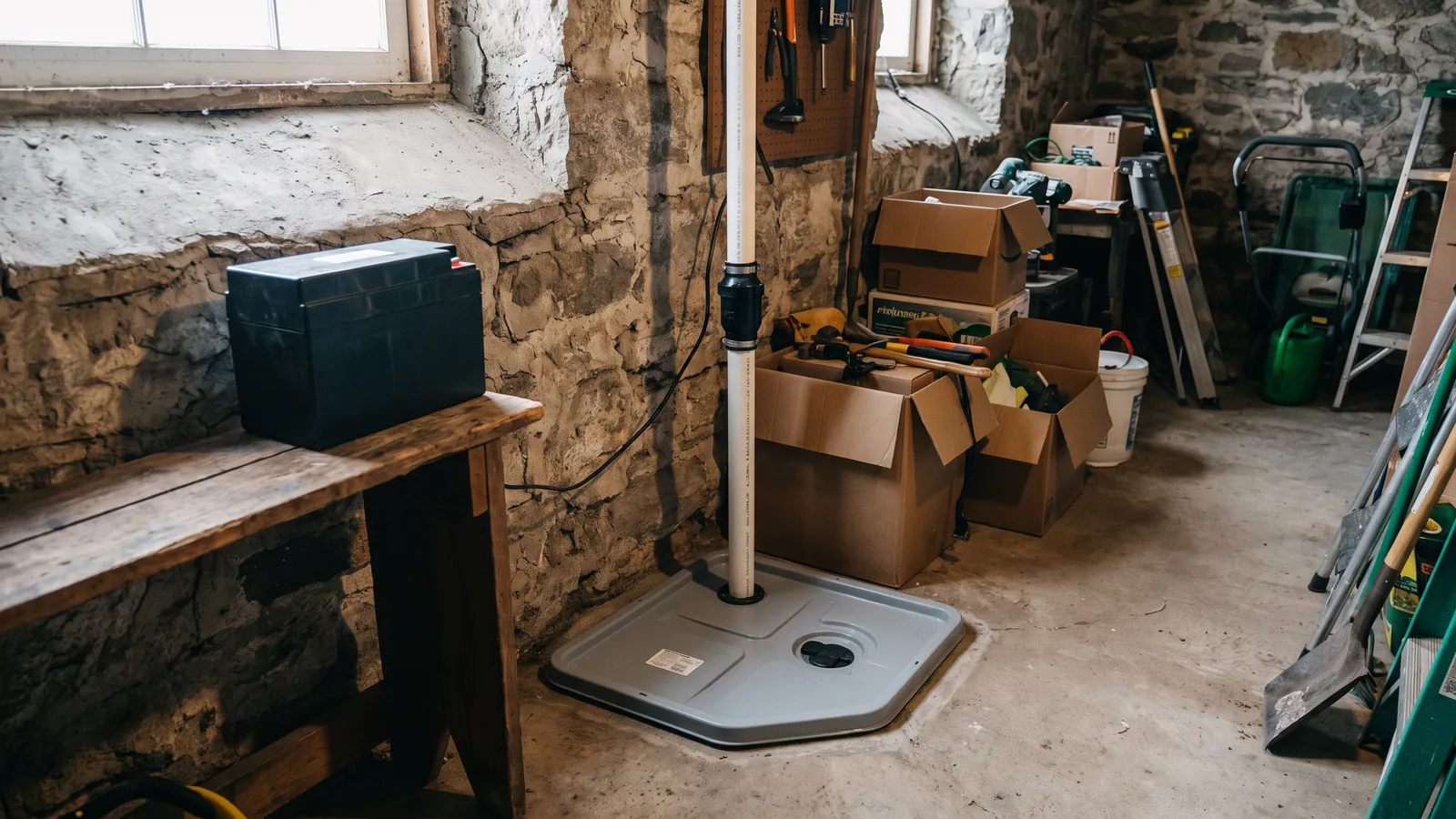
Encapsulation turns the crawl space from a damp outdoor cellar into a dry, closed part of the house. A reinforced liner, usually 20-mil, covers the ground and runs up the foundation walls and around each pier, with the seams overlapped and taped and the top edge fastened and sealed. The foundation vents and the access door are closed off. A dehumidifier sized to the volume of the space holds the humidity down, draining to the outside or to a pump. Where water actually enters during storms, a drain line and a sump go in under the liner before anything is sealed.
Why bother here? Bowling Green averages close to fifty inches of rain and snowmelt a year, the clay under most yards holds that water for a long time, and a July afternoon brings warm, humid air through every vent. That air meets cooler ductwork, cold-water pipes and joists and gives up its moisture right there. The results are familiar: a musty smell in the hallway, batts of insulation sagging out of the joists, ductwork beaded with water, rusty nail heads and, given enough years, soft wood. The Kentucky Geological Survey also flags radon as a concern on the sinkhole plain, where about 60 percent of the readings in one mapped unit came in above the EPA limit. A liner is not a radon system, but a sealed crawl space is a good moment to test, and we will tell you so.
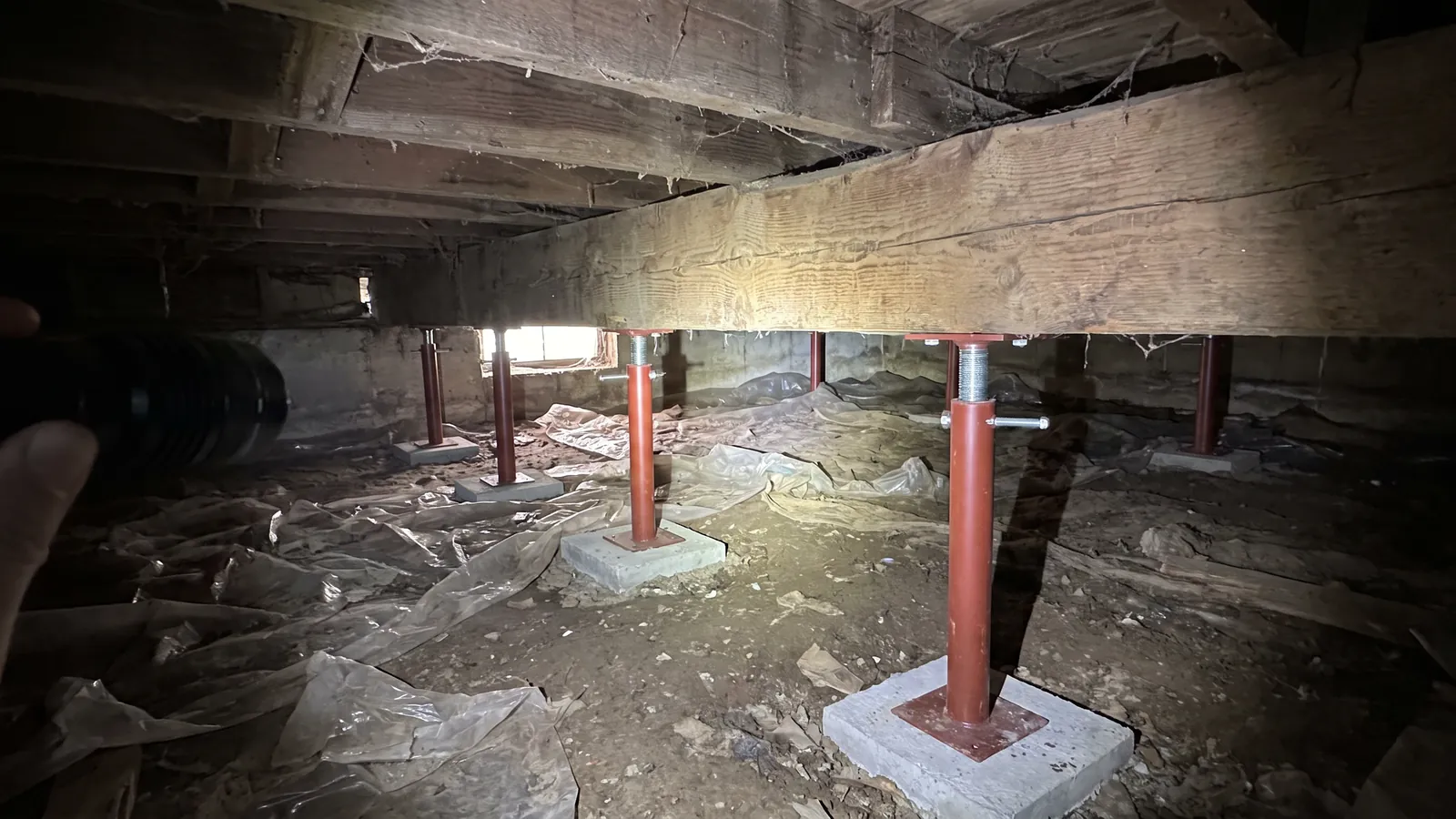
Order matters. Sealing a crawl space that floods every spring traps the problem inside, so water gets handled first: gutters and downspouts, the slope of the yard, a French drain outside if the ground keeps feeding the space, and an interior drain to a sump pump where water still finds its way in. Sagging girders and failing piers are repaired next, since a liner wrapped around a sinking block pier only hides the next round of trouble; the crawl space repair page covers that work. The liner and dehumidifier come last.
One more check before the vents close: if a gas furnace or water heater sits in the crawl space, how it gets combustion air has to be settled first. We look at that on the inspection and plan around it rather than discovering it on install day.
What the job covers
Ground and walls sealed
Reinforced liner across the floor, up the walls and around each pier, seams overlapped and taped, top edge fastened and sealed.
Vents and door closed
Foundation vents blocked and sealed and the access door fitted and weatherstripped, so the summer air stays outside.
Dehumidifier sized to the space
Chosen by the crawl space's volume and drained to the outside or a pump, never to a bucket someone has to remember.
Water handled first
Gutters, grading, outside drainage and, where needed, an interior drain and sump installed before the liner goes down.
Framing checked first
Piers, posts and girders inspected and repaired before they disappear behind white plastic.
Combustion air reviewed
Any gas appliance in the crawl space has its air supply looked at before vents are closed.
Crawl space encapsulation cost in Bowling Green
| Item | Budget range | What moves it |
|---|---|---|
| Encapsulation, typical whole crawl space | $5,000 – $15,000 | HomeAdvisor range; national average about $5,500 |
| Basic encapsulation | $2 – $4 / sq ft | Liner and sealing with little preparation |
| Extensive encapsulation | $3 – $10 / sq ft | Drainage, wall work and repairs; This Old House cites the same span |
| 20-mil vapor barrier, material only | $0.50 – $0.70 / sq ft | HomeAdvisor figure |
| Crawl space dehumidifier, installed | $800 – $2,000 | Including the electrical hookup |
| Sump pump, when water gets in | $600 – $2,500 | Fixr range; see sump pumps |
Ranges are national figures from HomeAdvisor, This Old House and Fixr. The size of your crawl space, how much clearance there is, and whether drainage or framing work comes first set the real number, which you get in writing after the inspection.
Picking the liner
| Liner | Where it fits | Trade-off |
|---|---|---|
| 6-mil plain poly | Ground cover in a vented crawl space nobody enters | Tears under knees and tools; not a sealed system |
| 12-mil reinforced | Light-traffic spaces with few obstacles | Lower cost, less forgiving on rough clay and stone |
| 20-mil reinforced | Full encapsulation and any space people work in | Costs more per foot, survives service visits for years |
What this work looks like
Crawl space encapsulation: what homeowners ask
Will encapsulation stop the musty smell?
In most houses, yes, because the smell comes from damp soil, wet framing and the growth that lives on them. Once the ground is sealed and the air is held below roughly the humidity where that growth thrives, the source dries up. If the smell is coming from a plumbing leak or a dead animal, we will find that first.
Do I really need a dehumidifier if the liner is in?
Usually. The liner stops vapor from the ground, but a closed crawl space still needs its air dried, especially through a humid Kentucky summer. A few houses with conditioned air supplied to the crawl space can manage without one; we will say which you have.
Can you encapsulate a crawl space that floods?
Not until the water has somewhere else to go. We put in outside drainage or an interior drain and sump first, then seal. Sealing over standing water is how liners turn into waterbeds.
Should I insulate the walls or the floor?
Once a crawl space is sealed, the insulation usually belongs on the foundation walls rather than between the floor joists, so the space stays near the temperature of the house. Old floor batts that are wet or falling get removed.
Does encapsulation fix radon?
No, a liner is not a mitigation system. The Kentucky Geological Survey notes radon is a concern on the sinkhole plain, so test after the work, and if the number is high, a radon contractor can tie a vent system into the sealed space.
Is the liner tough enough to crawl on?
A 20-mil reinforced liner is made for it: plumbers, HVAC techs and our own crews can kneel and slide on it without tearing through. Thin 6-mil sheeting is not, which is why we do not use it for a full encapsulation.